Free UK/DE/FR/IT/ES/US Shipping, Other Countries (Free on Orders Over £50) SHOP NOW

Do you ever feel like this?
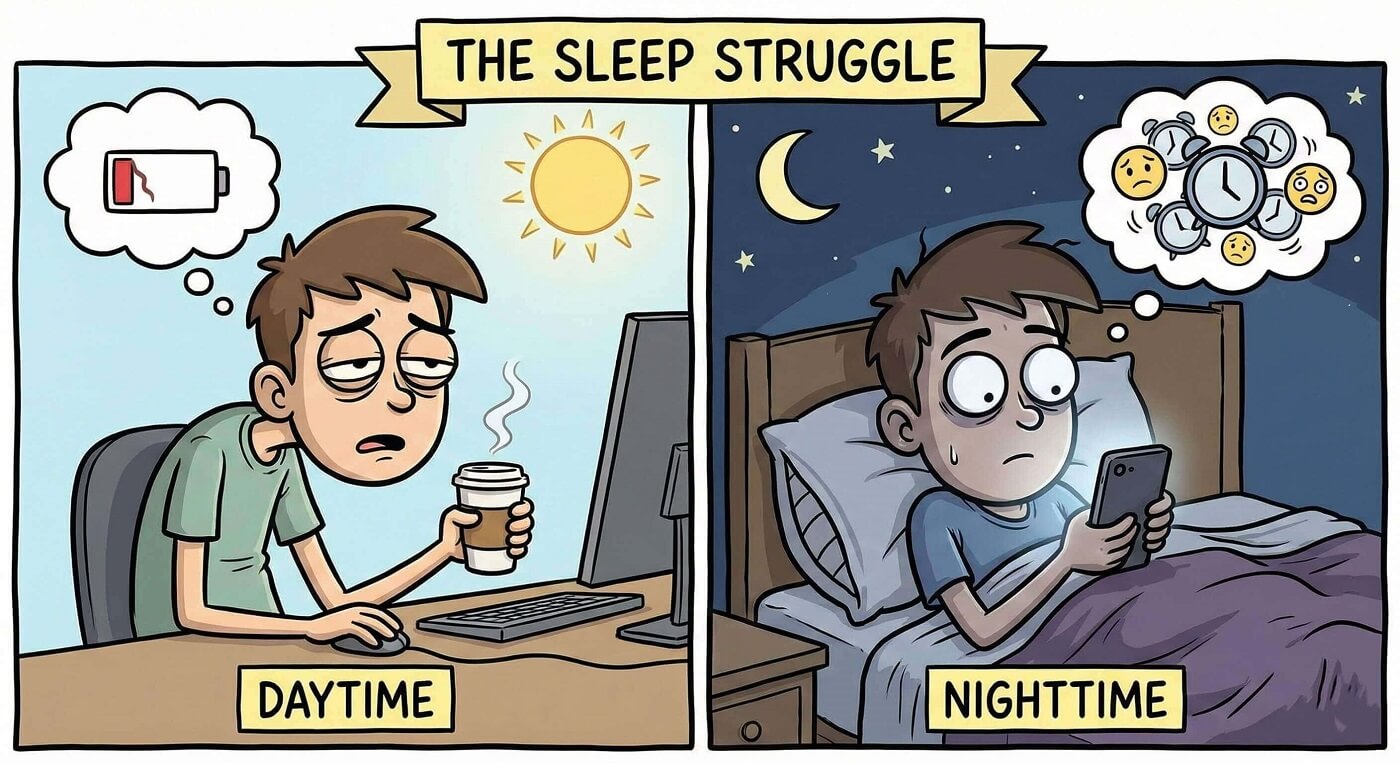
It’s 2 AM. You’re tossing and turning, staring at the ceiling, wondering where it all went wrong.
Or maybe you finally managed to drift off, only to wake up for no reason two or three times, unable to fall back asleep.
And then, you do the one thing that ruins everything:
You grab your phone.
In the pitch-black room, the blue light from the screen pierces your eyes like a needle.
Your brain might still be half-asleep, but your retinas are already screaming to your body: “IT’S MORNING!”
And just like that, any shred of sleepiness evaporates.
You think this is just a “bad night”?
No.This is a war against your Circadian Rhythm.
It’s not your mattress, and it’s not that you didn’t drink enough coffee.
The problem lies in your Light Diet.
Humans evolved for millions of years to rise with the sun and rest with the sunset. But now? We hide in dimly lit offices during the day and stare at screens brighter than the sun at night.
Your Circadian Rhythm is completely out of whack.
You need to recalibrate your biological clock. This isn’t just about sleep; it’s about your combat readiness during the day.
How is your biological clock being “hijacked”?
Sound like pseudoscience? It’s not. This is pure biology.
We need to dive deep into why light controls your body.
Melatonin Suppression
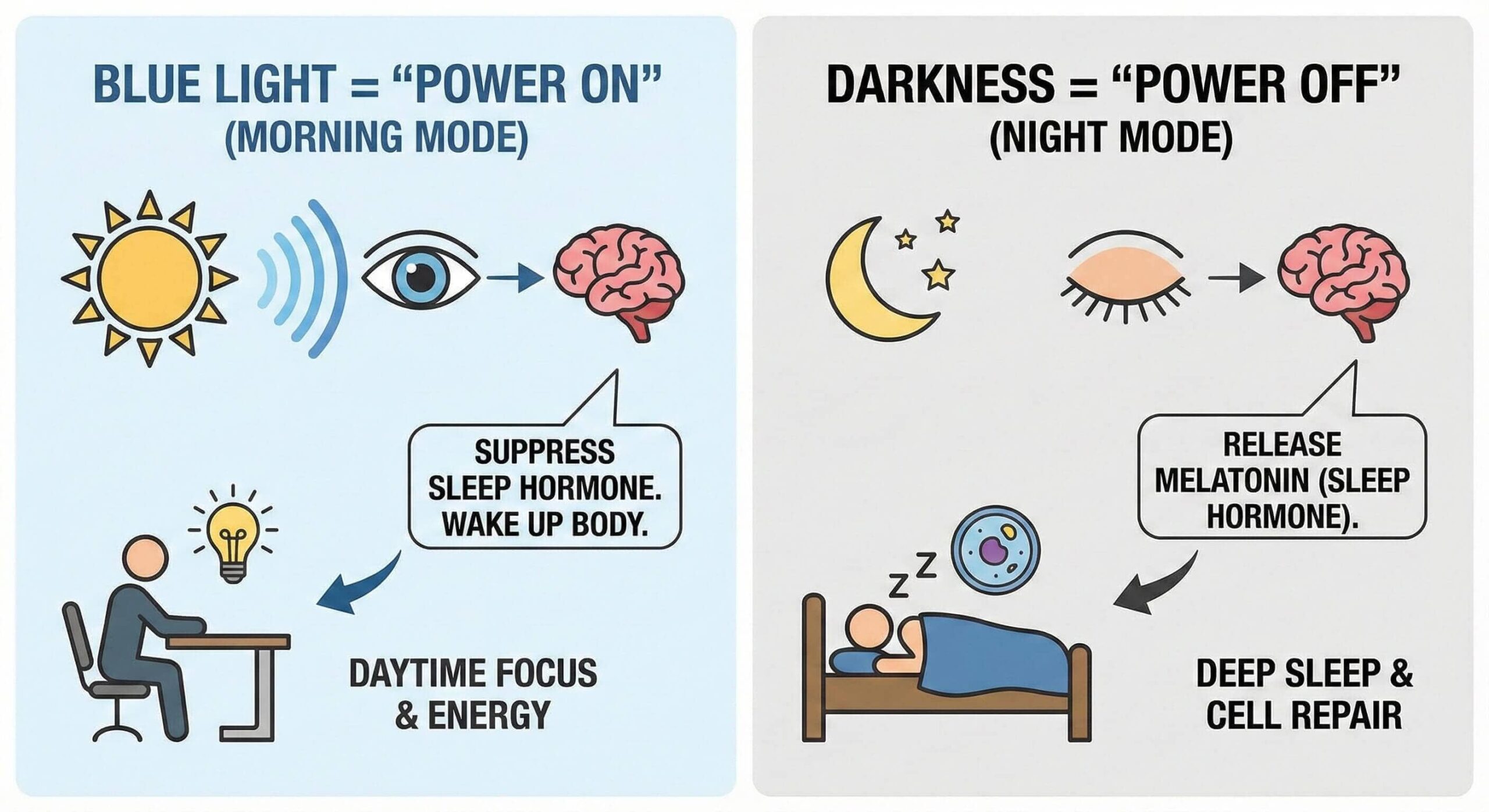
Melatonin is the key hormone that induces sleep. Specific wavelengths of light (mainly 460-480nm blue light) send a “daytime” signal to the brain, causing the pineal gland to immediately stop secreting melatonin.
Melatonin is your body’s brake fluid.When you scroll through your phone before bed, that blue light acts like a reckless driver cutting the brake lines. Without the cooling, calming effect of melatonin, your brain is left revving in the dark—overheating engine, but unable to stop.
The Suprachiasmatic Nucleus (SCN)
This is a tiny cluster of cells located in the hypothalamus, acting as the master pacemaker of our biological clock. It directly receives light signals from the retina and coordinates the rhythm of organs throughout the body based on that data.
Think of it as the conductor of your body’s orchestra. When he sees the sun, he waves his baton, signaling your liver, heart, and brain to play the ‘Daytime Movement.’
But late at night, the blue light from your phone is false intel. He is forced to strike up a ‘Daytime March’ at midnight, dragging organs that should be off the clock into emergency overtime. Once the rhythm is off, your body is thrown into total chaos.
Spectral Effects of Light
Not all light is created equal.
Blue Light: This is nature’s “digital caffeine.” Ancestrally, it existed only in the blazing midday sun, designed to keep you hyper-alert.
Red Light: This is more like a warm campfire. It has a negligible effect on your biological clock, simply signaling to your brain: “The light is fading; time to enter dreamland.”
Unfortunately, modern life has completely flipped this script: By day, we hide in dimly lit rooms (light starvation), but by night, we blast an “artificial sun” inches from our eyes (light overload).
What the Data Says
Don’t just take my word for it.
Let’s look at what scientists have discovered in the lab regarding how light manipulates you on a physiological level.
Study 1: The Power of Wavelength
Harvard Medical School confirmed: Not all light is harmful; specific wavelengths are the culprit.
Scientists compared the effects of blue light versus green light of equal brightness on the human biological clock. The results showed that blue light suppresses melatonin for twice as long as green light. Its stimulation of the brain is devastating.
Just reading under blue light for a few hours (like reading an e-book) can forcibly shift your circadian rhythm by 1.5 to 3 hours. Your body thinks it is 3 hours earlier than it actually is—of course you can’t fall asleep.
Study 2: Spectrum Perception
Research reveals an interesting physiological phenomenon: Your eyes recognize the spectrum, not the environment.
Researchers tested melatonin secretion in people in a bright environment where the blue light component was filtered out. The results were astonishing. As long as the blue light was filtered, the subjects’ melatonin levels were almost identical to those sitting in dim light.
This proves that “Spectral Deception” works. Even if the room is bright, as long as you cut off the specific blue light signal, the brain mistakes it for “darkness” and begins preparing for sleep.
How to Maintain a Healthy Circadian Rhythm?
Now that we know the principles, we must act.
Want to reclaim your energy? You need a “Circadian Rhythm Hacking Protocol.”
Morning: Chase Light Like a Sunflower
The first thing you do after waking up: Do not look at your phone.
Get outside. Step onto the balcony or walk downstairs to buy a coffee.
You need at least 10-15 minutes of direct natural light (not through a windowpane). This shoots an “ON signal” to your brain, spikes cortisol levels, and sets the countdown timer for tonight’s sleep.
Seriously. Even on a cloudy day, outdoor light is 10 times stronger than indoor light.
All Day: Circadian Rhythm Glasses Combo
This is the most critical step. Since we can’t escape screens, we must put “protective suits” on our eyes.
We recommend a Day & Night combination:
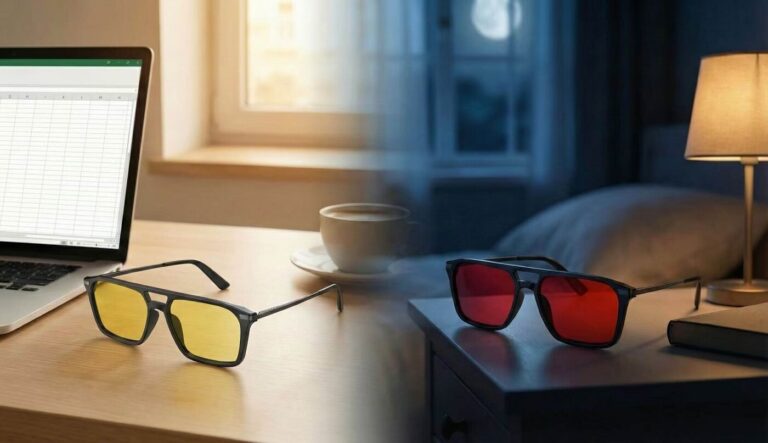
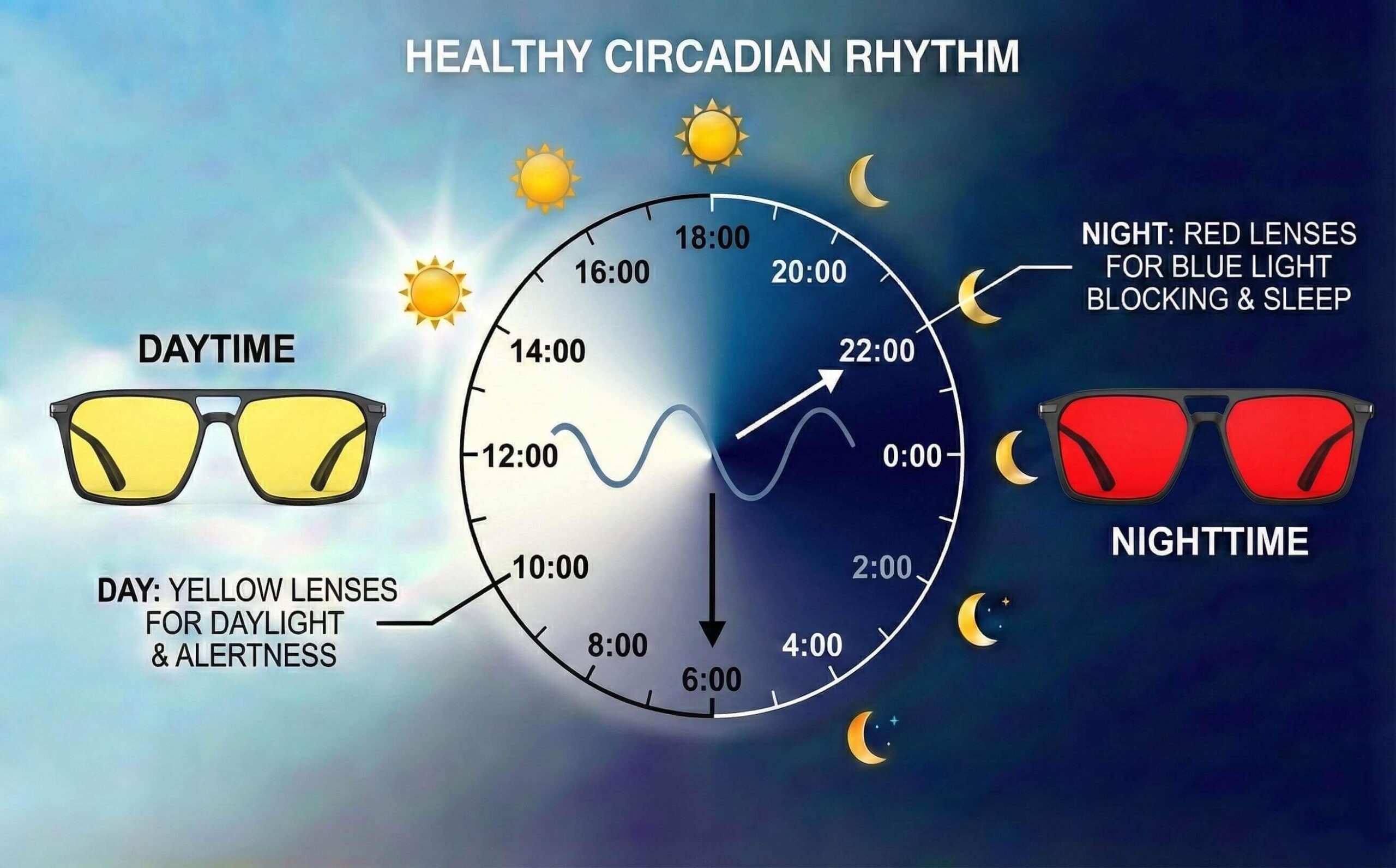
Daytime (9 AM – 6 PM): Use Yellow Lenses Glasses. They filter out the harsh, harmful peaks of blue light but retain beneficial blue-green light, keeping you awake and focused while eliminating eye strain.
Nighttime (1 hr Before Bedtime): Switch to Red Lenses Glasses. This artificially creates a “sunset.” They block 100% of blue and green light, forcing the brain to secrete melatonin.
Before Bed: Digital Curfew
I know this is hard.
But try to turn off all unnecessary screens 60 minutes before bed.
If you must use a phone or computer, you must wear the red glasses mentioned above and dim the screen to the lowest setting.
Turn your bedroom into a complete black hole. Even a tiny light from a charger can interfere with your deep sleep. Seal them with black electrical tape.
Conclusion
A sleep expert once asserted: ‘Light is the most potent agent to synchronize your biological clock.’
Controlling your light is controlling your life.
In this modern society full of artificial light, protecting your circadian rhythm is not a luxury—it is a survival skill.
Don’t let screens steal your sleep and energy.
Starting today, give your eyes a little bit of that “sunset” tenderness.
View Scientific Sources
Harvard Medical School – Division of Sleep Medicine. (n.d.). Blue light has a dark side. Retrieved from Harvard Health Publishing:
https://www.health.harvard.edu/staying-healthy/blue-light-has-a-dark-side
Wahl, S., Engelhardt, M., Schaupp, P., Lappe, C., & Ivanov, I. V. (2019). The inner clock-Blue light sets the human rhythm. Journal of biophotonics, 12(12), e201900102.
https://doi.org/10.1002/jbio.201900102
Smies, C. W., Bodinayake, K. K., & Kwapis, J. L. (2022). Time to learn: The role of the molecular circadian clock in learning and memory. Neurobiology of learning and memory, 193, 107651. https://doi.org/10.1016/j.nlm.2022.107651
Lee, H. H., Tu, Y. C., & Yeh, S. L. (2021). In search of blue-light effects on cognitive control. Scientific reports, 11(1), 15505.
https://doi.org/10.1038/s41598-021-94989-6
Bonmati-Carrion, M. A., Arguelles-Prieto, R., Martinez-Madrid, M. J., Reiter, R., Hardeland, R., Rol, M. A., & Madrid, J. A. (2014). Protecting the Melatonin Rhythm through Circadian Healthy Light Exposure. International Journal of Molecular Sciences, 15(12), 23448-23500.
https://doi.org/10.3390/ijms151223448